Limiti di velocità; pericolo e intralcio alla circolazione; comportamenti ai passaggi a livello
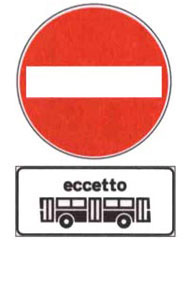
Il segnale in figura vieta l'accesso agli autobus
Show the answer
Official answer: FALSO
False: The sign does not prohibit access to buses. A bus access ban would need a specific prohibition, so the statement misreads the rule.
Il conducente deve regolare la velocità in relazione alle condizioni della strada
Show the answer
Official answer: VERO
True: A driver must always adapt speed to the road conditions, including surface, visibility, traffic and weather.
Il conducente deve regolare la velocità tenendo conto esclusivamente dei limiti massimi
Show the answer
Official answer: FALSO
False: Speed must not be based only on maximum limits. Drivers must also consider road, traffic, visibility and weather conditions.
E' obbligatorio regolare la velocità in prossimità delle intersezioni
Show the answer
Official answer: VERO
True: Near intersections, speed must be regulated so you can stop or yield safely if necessary.
E' obbligatorio regolare la velocità nei tratti di strada fiancheggiati da edifici
Show the answer
Official answer: VERO
True: On roads flanked by buildings, speed must be regulated because of pedestrians, side exits and limited visibility.
E' obbligatorio regolare la velocità nelle ore diurne ma non in quelle notturne
Show the answer
Official answer: FALSO
False: The duty to regulate speed applies at all times, day and night. Night driving often requires more caution.
E' obbligatorio ridurre la velocità e all'occorrenza fermarsi quando riesce malagevole l'incrocio con altri veicoli
Show the answer
Official answer: VERO
True: When passing other vehicles is difficult, you must slow down and, if needed, stop to avoid collision.
E' obbligatorio ridurre la velocità e all'occorrenza fermarsi in prossimità degli autovelox
Show the answer
Official answer: FALSO
False: Speed cameras enforce speed limits; there is no obligation to slow down or stop specifically near them unless safety requires it.
Il limite massimo di velocità per un autocarro fino a 3,5 tonnellate sulle strade extraurbane principali è di 110 km/h
Show the answer
Official answer: VERO
True: For goods vehicles up to 3.5 tonnes, the maximum on main extra-urban roads is 110 km/h.
Il limite massimo di velocità per i quadricicli non leggeri, fuori dai centri urbani, è di 80 km/h
Show the answer
Official answer: VERO
True: Non-light quadricycles have a maximum speed of 80 km/h outside built-up areas.
Il limite massimo di velocità per un autocarro di massa complessiva fino a 3,5 tonnellate sulle autostrade è di 120 km/h
Show the answer
Official answer: FALSO
False: A goods vehicle up to 3.5 tonnes may not travel at 120 km/h on motorways; its limit is 110 km/h.
Il limite di velocità sulle autostrade per coloro che hanno conseguito la patente da meno di 3 anni è di 100 km/h
Show the answer
Official answer: VERO
True: Drivers with less than three years of licence have a motorway limit of 100 km/h.
Il limite di velocità sulle strade extraurbane principali per coloro che hanno conseguito la patente da meno di 3 anni è di 110 km/h
Show the answer
Official answer: FALSO
False: For drivers with less than three years of licence, the limit on main extra-urban roads is 90 km/h, not 110 km/h.
Il limite massimo di velocità sulle strade extraurbane principali è di 70 km/h per autovetture con rimorchio per trasporto imbarcazioni
Show the answer
Official answer: VERO
True: A car towing a trailer for transporting boats has a maximum of 70 km/h on main extra-urban roads.
Il limite massimo di velocità su strade extraurbane principali è di 100 km/h per i motocicli
Show the answer
Official answer: FALSO
False: The maximum for motorcycles on main extra-urban roads is 110 km/h, not 100 km/h.
La velocità deve essere moderata nei tratti di strada a visuale non libera
Show the answer
Official answer: VERO
True: Where visibility is not clear, speed must be moderated so you can react safely.
Salvo diversa segnalazione, il limite massimo di velocità consentito è di 50 km/h nei centri abitati
Show the answer
Official answer: VERO
True: Unless otherwise signposted, the maximum speed in built-up areas is 50 km/h.
Salvo diversa segnalazione, il limite massimo di velocità consentito per i quadricicli non leggeri è di 70 km/h.
Show the answer
Official answer: FALSO
False: Unless otherwise signposted, non-light quadricycles have a maximum of 80 km/h, not 70 km/h.
Su strade extraurbane principali il limite massimo di velocità è di 80 km/h per autovetture con rimorchio leggero
Show the answer
Official answer: FALSO
False: A car towing a light trailer on main extra-urban roads is limited to 70 km/h, not 80 km/h.
Il limite massimo di velocità su strade extraurbane secondarie è di 70 km/h per autotreni
Show the answer
Official answer: VERO
True: On secondary extra-urban roads, the maximum for articulated lorries is 70 km/h.
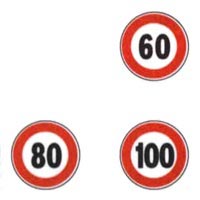
I contrassegni rappresentati in figura sono applicati sulla parte posteriore di alcune categorie di veicoli
Show the answer
Official answer: VERO
True: Such markings are placed on the rear of certain vehicle categories to inform following drivers.
La velocità deve essere particolarmente moderata in prossimità di un incrocio
Show the answer
Official answer: VERO
True: Speed must be particularly moderate near an intersection, where vehicles and pedestrians may cross.
Si deve regolare la velocità in base alla fretta del conducente
Show the answer
Official answer: FALSO
False: Speed must be regulated by safety and traffic conditions, not by the driver's hurry.
Salvo diversa segnalazione, il limite massimo di velocità sulle strade extraurbane principali è di 100 km/h
Show the answer
Official answer: FALSO
False: Unless otherwise signposted, the maximum on main extra-urban roads is 110 km/h, not 100 km/h.
Lungo le corsie di canalizzazione, è possibile che nella corsia di destra si circoli ad una velocità superiore a quella di sinistra
Show the answer
Official answer: VERO
True: In canalisation lanes, the right lane may flow faster than the left if the left lane is for turning or queuing.
Il limite massimo di velocità sulle strade extraurbane secondarie è di 90 km/h per le autovetture che trainano un rimorchio per il trasporto di gommoni o alianti
Show the answer
Official answer: FALSO
False: A car towing a trailer for boats or gliders on secondary extra-urban roads is limited to 70 km/h, not 90 km/h.
In caso di arresto forzato di un veicolo sui binari di un passaggio a livello, bisogna spostarlo, spingendolo quanto prima fuori dai binari
Show the answer
Official answer: VERO
True: If a vehicle stops on level-crossing tracks, it must be moved off the tracks as soon as possible.
Nei veicoli dotati di servofreno, se si percorre una lunga discesa con il cambio in folle e a motore spento, diventa sempre più difficoltoso arrestare il veicolo
Show the answer
Official answer: VERO
True: With the engine off, servo assistance is lost, so braking a vehicle on a long downhill becomes increasingly difficult.
Nel caso in cui, per un guasto alla propria autovettura, si rimane bloccati sulla sede ferroviaria di un passaggio a livello, occorre adoperarsi per rimuovere il veicolo al più presto, ad esempio facendosi aiutare da altri utenti a spingere il veicolo fuori dalla linea ferroviaria
Show the answer
Official answer: VERO
True: If a breakdown blocks a level crossing, remove the vehicle from the tracks immediately, using help if needed.
Nel caso in cui, per un guasto al veicolo, si rimane bloccati sulla sede ferroviaria di un passaggio a livello, occorre scaricare rapidamente il veicolo per salvare almeno il carico
Show the answer
Official answer: FALSO
False: The priority is to clear the railway tracks and prevent danger, not to unload the vehicle to save the cargo.